“We make our world significant by the courage
of our questions and the depth of our answers.“
Carl Sagan
No specific vacancies with the group are currently advertised
but please read because other pathways to work together are possible.
The overarching goal of our laboratory-based work is – How did/do habitable Earth (and like) worlds form and evolve?
Possible research projects
Interested and enthusiastic candidates are encouraged to get in touch to discuss their relevant ideas for exciting research projects! I’m sure you bring some great thoughts, which you can potentially shape into a 1 or 2 page proposal.
In particular, as a geo/cosmochemist and dominantly hot (melt) and/or deep rock lady I am keen to hear from eager undergraduate or masters students concerning their thesis projects, Ph.D candidates, and postdoctoral researchers. Especially those keen to interrogate natural samples to reveal new knowledge via original studies that (learn to-) use:
- petrographic / optical microscopy,
- quantitative composition characterisation of minerals,
- [inorganic] major, minor, and trace element abundance systematics,
- isotopic geochemical characteritics,
- and associated interpretations that may draw on some numeric / thermodynamic modelling.
The above diagnostic constraints to be determined and scrutinised for favourite kinds of natural rocks (soils or dusts) from space (+ their constituent minerals) +/- Earth rocks. +/- field work where required.
With scope for some intellectual work that purposefully compares-contrasts selected analogue sites on Earth to important aspects of planetary research.
Contact form or email ariches [AT] setiap.org Scotland-based, UK
My own established expertise also includes designing and driving advances in- and applying ultra-low-blank highly siderophile element geochemistry with associated high-precision isotopic tracers.
Plus, please get in touch too if you are an academic or group/professional body interested in realising larger ventures. Such as via partner or network grants, including bilateral or multilateral programmes with planet formation / solar system science and space mission connections, and/or via European COFUND actions.
Also, my passionate team and I are open to contributing to public engagement / creative communication activities as able.
Planned work falls under or cross-cuts the following broad themes:
- Asteroids and the infant stages of planetary growth (as constrained by meteorites +/- returned samples)
- Comparative planetology
- The geological characteristics, processes, and history of the Moon
- The geologic evolution and environments of Mars (and Phobos)
- The interior and bulk composition, and long-term (chemical/geodynamic) evolution of Earth
(Largely drawing on messages among ultramafic and mafic rock series alongside integration of big-picture appraisals of empirical geochemical data and arising models, with possibilities to include scientifically powerful examples among Scotland’s geology and to compare to understanding from wider planetary / Solar System science.) - Plus, if feasible, I accomodate support of collaborative work on wider projects and coordinated initiatives.

Thank you to prior funders. Scroll down for a list of possible funders to your research ideas.
To give a few examples, the types of questions we consider and link to include:
> Precisely how are Earth and planetary magmas generated from what exact starting materials at what depth, and what forms of residue do they leave? And how do magmas evolve as they seperate from the residue left behind, travel, and crystallise? What does this information tell us about the mean and variance of crust, mantle, and core compositions for a given ‘differentiated’ body?
> How do the above types of processes and the recipe for Earth (including possible traces of core formation, past magma oceans, and a final few percent added during so-called ‘late accretion’) compare or contrast to other bodies in the Solar System, and why?
> If late-accretion is a robust theory, is it important to habitability and the life in our Solar System?
> How is the empirical information we provide understood and used (well) to understand the construction and modification of rocky bodies through impacts? How has, and does, planetary magmatism shaped the evolution of planetary atmospheres and envionments?
> What can our observations also tell us of the nature and rhythmn(s) of crust-mantle evolution and consequent effects for surface settings, (+/-bio)geochemical cycles, the rise and evolution of life and – for Earth – civilsation?
The analytical expertise, ways of thinking, and theoretical frameworks that team members specialise in have broad applications, and the skills you develop as part of this team will appeal to a range of future employers that students and early career postdoctoral colleagues may be interested in.
—————-
Understanding of geological processes, geochemical cycles, planet-scale compositions and their long-term evolution is foundational to broad Planetary, Earth, Environmental and Sciences – which help us save the world from the climate crisis whilst exploring and progressing knowledge of our Solar System.
Our work also connects with international cross-discipline strategic and responsible activity, mission designs, and governance in space exploration – a driver of frontier knowledge, as well as inventions / innovations useful to tackling challenges and supporting healthy lives on Earth. And our original findings and ideas, along with consequent mandates that drive wider community progress, inform the broad concepts for understanding more distant worlds (exoplanets) and searches for possible life elsewhere across the cosmos. Plus, our work, stewardship, and community thought spans humanities, cultural, creative, health, heritage, ethical and legal aspects.
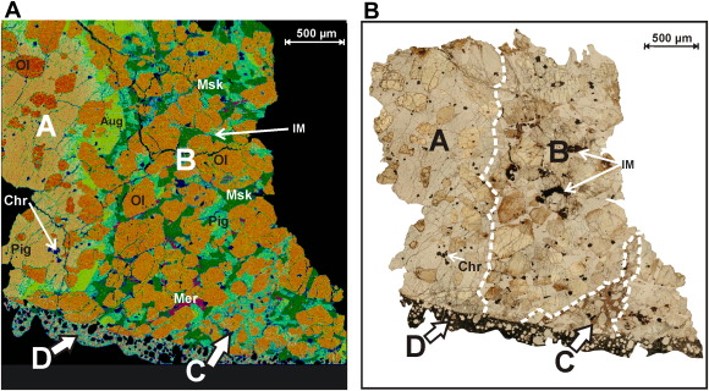
False colour composition map and transmitted light image depicts Martian meteorite Yamato 984028, Riches et al 2011.
Interested students and others
- For school students, L’Oréal Foundation For Girls in Science
- Undergraduate summer internships (meteorites), Paneth Trust
- Masters, Ph.D, and other Commonwealth Scholarships
- Masters or (after Ph.D) Early Academic Fellowship
– British Council Women in STEM - For women from countries with developing or emerging economies
– Schlumberger Foundation - International – The Bseiu Foundation scholarships
- The Carnegie Trust for Scotland – several provisions
- The Carnegie Trust for Scotland’s Ph.D Scholarships
—-
- Student Award’s Agency Scotland – possible support for students satisfying residency criteria
- International – Full list of British Council Scholarships
- India-UK Masters, Ph.D, visiting programmes and others –
The Inlaks Shivdasani Foundation
UK-India Education and Research Initiative - Amelia Earhart Fellowship
- China Scholarships Council
- International – British Chevening and Saltire Scholarships
—–
- US to UK pre-university / undergraduate experience / postgraduate / professional
-> from the USA to UK, or from the UK to USA - US to UK 1 or 2 year Marshall Scholarships for postgraduate study
- Japan-Scotland Society
- (Students from Spain and Portugal) La Caixa
- Canadian Centennial Scholarship Fund
- Bursaries and awards listed by the Geological Society
- Research funds listed by the Geological Society
- Meteoritical Society Endowment Fund
- Royal Astronomical Society
- Royal Society of Edinburgh
- John Templeton Foundation
- National Geographic Society
—-
- Women in Science resource
- Check individual universities for any British Council Women in STEM allocations they have secured for a current year. (Info for institutions)
- See also, SavetheStudent
Interested Early Career Fellows and others
- If required and where eligible, to support preparation of Fellowship applications you may consider STFC’s Return to Research Support Bursary
- Geological Society’s Fermor Seed Corn Fund (including provisions for partnerships with India, those who have had non-traditional roles or are returning from career breaks).
- Royal Society Rosalind Franklin Award and Lecture (promoting women in STEM)
- Marie Sklodowska-Curie Fellowships
- Royal Society Career Development Fellowships for ECRs of underrepresented backgrounds.
- Royal Society Newton International Fellowships
- Leverhulme Early Career Fellowships
- Broader range of Commonwealth funding provisions
——
- Swiss National Science Foundation Postdoctoral Mobility
- (Overseas partner[s]) RSE Saltire EC Fellowships and Saltire International Collaboration
- STFC Ernest Rutherford Fellowships
- Royal Society Dorothy Hodgkin Fellowship
- Daphne Jackson Trust Fellowship
- L’Oréal for Women in Science awards
- Royal Commission 1851 Fellowships
- UKRI Future Leaders Fellowships
- Branco Weiss Fellowship
- For suitable topics, UK’s NERC Independent Research Fellowships
- Other pathways listed with UKRI
——
- RSE Enterprise Fellowships
- If in post, Royal Society of Edinburgh Personal Fellowships
- Royal Society Entrepreneur in Residence
- (From Hong Kong) Croucher Fellowships
- (From Finland) Säätiöiden post doc -pooli
- For women from countries with developing or emerging economies – Schlumberger Foundation
——
- (Outgoing to) Singapore National Research Fellowships
- (Outgoing to) Japan Society for Promotion of Science (JSPS) Postdoctoral Fellowship
- (Outgoing to USA) Examples Lindemann Trust Fellowship,
Royal Society of Edinburgh Fulbright Scholar Award, and a good number of further schemes. - (Outgoing to Germany, Max Planck Institutes) Lise Meitner Excellence Programme
– for outstanding women early career scientists - (Outgoing to / partnership / other) SETI Institute Research
Baruch S. Blumberg and The William J. Welch Fellowship Fellowships and other schemes
Carl Sagan Center, Mountain View, California, USA. - (Outgoing to) ISSI, Bern, Johannes Geiss Fellowship or their other schemes
- (Outgoing to) European Space Agency – Research Fellowships in Space Science
—–
- For those with spin-out/business leaning interests – Scottish Enterprise
- Examples (not exhaustive list) for variously experienced academics:
– Royal Society Faraday Discovery Fellowship (~10 to 20 years post-PhD, career breaks taken into consideration)
– Announcements of opportunities with the UK Space Agency, including for bilateral space science and exploration, exploration community development.
– Aurora Fellowships or calls (Mars science) and other exploration funding via UK Space Agency
– Leverhulme Visiting Professorships
– Royal Society Wolfson Fellowship
– Royal Society Wolfson Visiting Fellowship (up to 12 months)
– Royal Society Newton Advanced Fellowships
– Royal Society Research Professorships
– Royal Society Leverhulme Trust Senior Research Fellowship
– Royal Society of Edinburgh Bilateral Visits
– Other Royal Society Funding Schemes
– Other Royal Society of Edinburgh grants and collaboration
– Refugee or At Risk Academics are directed to CARA, for example. - Royal Society of Chemistry (with specific opportunities for technical staff)
Please be aware that for a number of Fellowships and learned society Visitor applications, internal competition (“demand management”) usually applies before proposals are selected for preparation in full. Interested students, visitors and Fellows may, in some instances, also identify funding pathways through their home national academies and other grant award bodies.
Donors
Are you fortunate enough to be able to help support promising students and exciting rocky science?
Potential philanthropic donors (businesses, groups, families, or individuals) are encouraged to get in touch if interested in sponsoring scholarships, a little (or a lot) of help for student research experiences or conference attendance, or other assistance for team members in need in higher education and research. Contact form. Thank you.

NOTE: If interested in engaging me for other work on a contractual basis
I will provide a quote based on information provided.
Please mark your message “consultancy request”.


 Amy J. V. Riches